ICE IN HER VEINS: Wolvaardt’s 100th T20I Moment


When Laura Wolvaardt made her T20I debut as a 16‑year‑old in 2016, South Africa were still a semi‑professional side playing in front of sparse crowds and juggling limited resources. A decade later, she leads the Proteas into her 100th T20I as captain of a fully contracted national side, playing in packed venues at a World Cup where every match is broadcast and analysed.

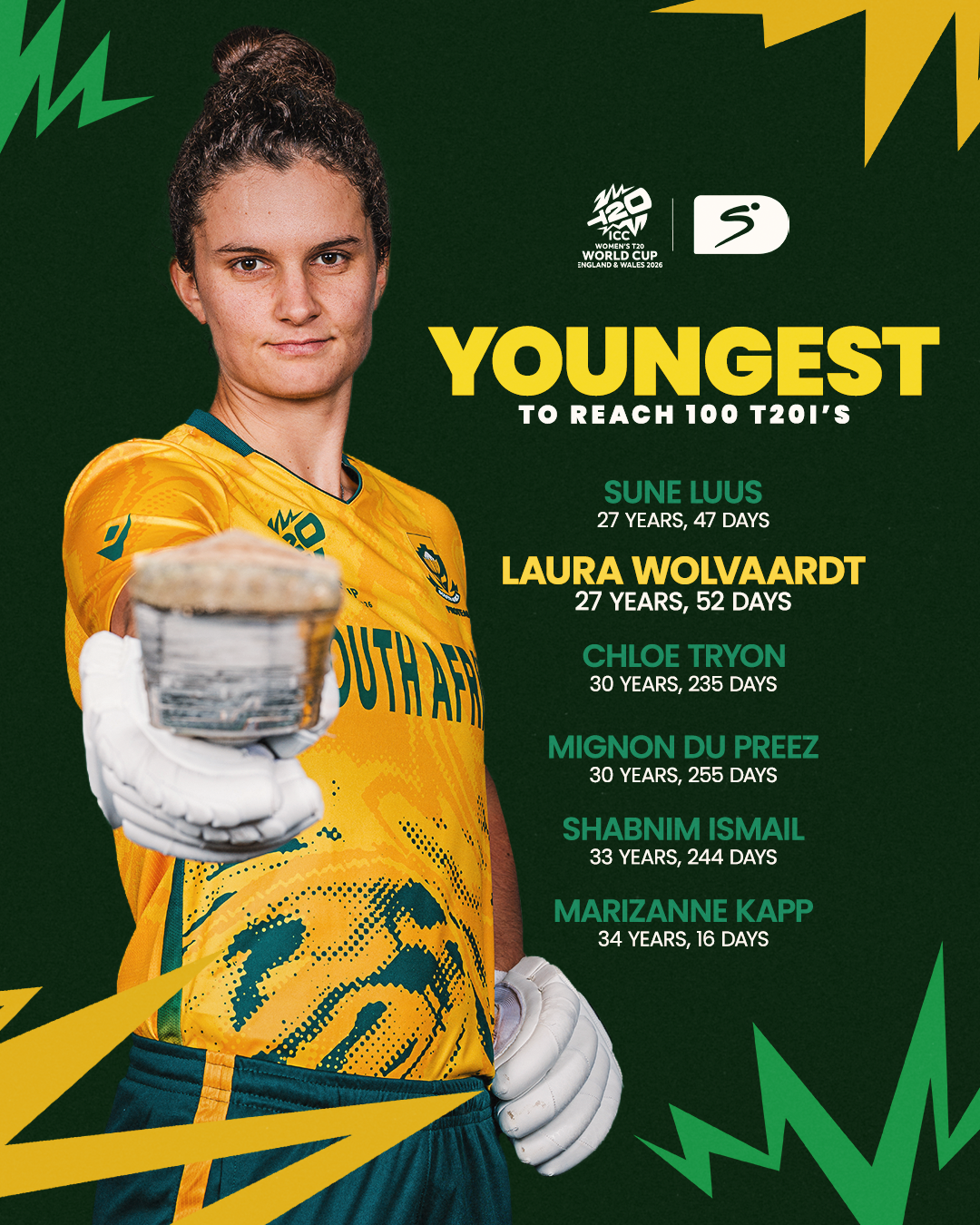
But one thing has not changed in those ten years: Wolvaardt remains as cool as several cucumbers lined up in the chiller. She is just the sixth South African woman to reach the milestone, but she is in good company. Four of the five players who reached triple‑figure appearances before her - Sune Luus, Chloe Tryon, Marizanne Kapp and Shabnim Ismail - are all part of the current T20 World Cup squad.
Advertisement
Wolvaardt has always led from the front. First to training and always the one to raise the intensity in the gym, fitness or nets, she is the quintessential cricketer - both in technique and demeanour. With a cover drive that would make Kumar Sangakkara blush and an aura of zen that could be its own mindfulness app, the 27‑year‑old is exactly what a dressing room full of strong personalities needs. That’s what wicketkeeper Sinalo Jafta thinks, anyway.
“Wolfy leads with integrity,” Jafta said. “She brings that calmness, and that is exactly what is needed with the type of team we have.”
That calm exterior has long been part of Wolvaardt’s mystique. Beneath the stillness is a ferocious competitor who never stops refining her craft and adapting to a format that once seemed too frenetic for her classical style.
As with so many technically pure players, there were early questions about whether her textbook technique could ever thrive in what some still call hit‑and‑giggle malarkey. But just as Mike Patton and Devin Townsend can shift from jazz‑trained, six‑octave, prim‑and‑proper musos to full‑blown chaos merchants, Wolvaardt has blended genres and reinvented her game without losing her fundamentals.
It didn’t take long for her to move from classical to controlled chaos. It began with her trademark cover drive. Then came the sweep shots. Then the pick‑up over midwicket. Then the willingness to take on spin in the powerplay. Then the acceleration through the gears that turned her from accumulator to match‑winner. And all of it happened without losing the Wolvaardt trademarks: the still head, the clean lines, the sense that she is playing the game half a second slower than everyone else.
One Remarkable Journey. 💯
From a teenage prodigy to captain of #TheProteas, Laura Wolvaardt is set to reach a century of T20I appearances. 👏
A milestone built on class, consistency and unwavering commitment. A leader at the crease and an inspiration beyond it. ✨🇿🇦… pic.twitter.com/O5CUV7F69t — Proteas Women (@ProteasWomenCSA) June 17, 2026
Her teammates have watched that transformation up close. They’ve seen the hours in the nets, the meticulous footwork drills, the quiet conversations with coaches, the way she studies bowlers without ever making a fuss about it.
And when the pressure spikes, Wolvaardt draws on that zen to ground herself. She refuses to panic, declutters decisions, and makes complicated chases look like just another day in the office - the hallmark of a sportsperson who never stops wanting to learn.
Her 100th cap, then, feels bigger than a number. It marks longevity, yes, but also leadership, consistency and the steady rise of a player who has become the heartbeat of the Proteas’ batting identity.
It also mirrors the rise of South African women’s cricket itself. The era of global finals, packed stadiums, central contracts and genuine belief has unfolded alongside Wolvaardt’s own ascent, just as she grew up alongside the senior players who reached their own centuries and who she now leads.
South Africa will need every bit of that composure in Birmingham when they take on Pakistan as they look to rebound from a heavy opening defeat to Australia.
The task is straightforward in theory and far more complex in practice: reset, respond and reassert themselves after a bruising start. The Proteas were undone by spin, scoreboard pressure and the kind of ruthless efficiency that has defined Australia for a decade. But this team has never been one to linger on a stumble, and the second match of a World Cup has often been where South Africa find their feet.
Conditions at Edgbaston are expected to offer more grip than zip, meaning the Proteas will once again need to navigate a spin‑heavy challenge. Pakistan have made no secret of their intentions: they will open with Sadia Iqbal, lean on Nashra Sundhu through the middle, and look to squeeze South Africa by taking the pace off and forcing errors.
For South Africa, the response begins at the top. Wolvaardt’s presence in her 100th T20I brings a sense of order to the chaos, and her ability to set the tempo will be central to how the innings unfolds. A calm start from the captain tends to ripple through the batting order, giving the middle a platform rather than a rescue mission. The Proteas will also look to their depth - Luus, Tryon, Brits, de Klerk - to absorb pressure and counterpunch when the spinners settle into rhythm.
With the ball, South Africa will want sharper execution in the powerplay and more control through the middle overs. Shabnim Ismail and Marizanne Kapp remain the spearheads, but Ayabonga Khaka’s quiet precision will be just as important in conditions that reward patience. The fielding unit, under new coach Mduduzi Mbhatha, will also be under scrutiny after a rusty outing against Australia.
Pakistan, for their part, arrive with their own urgency after falling short against India. Their batting can swing between brilliance and collapse, and South Africa know that early wickets tend to unravel their structure quickly.
In Birmingham, the result will matter, of course, but so will the moment. Wolvaardt walks into her 100th T20I not just as South Africa’s captain, but as the quiet constant in a team that has grown, stumbled, risen and redefined itself alongside her. The milestone stands as a testament to a decade of craft, composure and evolution – and to a player who has become the Proteas’ calm in the chaos.
Advertisement